Empowering students with language-based learning differences


Siena Blog



News
The Siena School Blog
Discover, Learn, Celebrate, and Empower
Welcome to Siena's blog, your source for helpful, cutting-edge resources tailored to teachers, parents, and other advocates in the learning differences community. We are dedicated to providing a wealth of curated knowledge spanning various topics, ranging from dyslexia advocacy and awareness to classroom teaching strategies, heritage month profiles, and social and emotional health.
Discover innovative classroom strategies that inspire creativity and foster a love of learning.
Our commitment to social-emotional wellness ensures that we provide valuable insights into healthy student development and self-advocacy.
Discover resources, reading and podcast recommendations, volunteering opportunities, and more for parents in the LD community.
Our important heritage month posts highlight key people, offer reading and podcast recommendations, and more.
Poetry and Liberation in the High School Classroom
January 07, 2026

Avg. read time 6-7 minutes
At Siena, our English curriculum is designed to reflect the identities of our students and those of underrepresented communities, especially if students are aware of social and political topics in their daily lives and on social media.
A cornerstone of our high school English 12 curriculum is the Poetry and Liberation unit. Like other Siena classes, English 12 differentiates student learning and highlights their strengths and agency in reading and writing projects.
High School Poetry Projects
When poetry is introduced in class, students tend to resist it for various reasons. Yes, poetry can be cryptic, abstract, and, in some ways, exclusive. As an art form, it is supposed to function as a way to express individual and shared experiences — often quite concisely, which can be an additional challenge for LD students.
Yet, in diverse classrooms, students may not be presented with poems that they can connect with, particularly those that are written by and for people who share their identities.
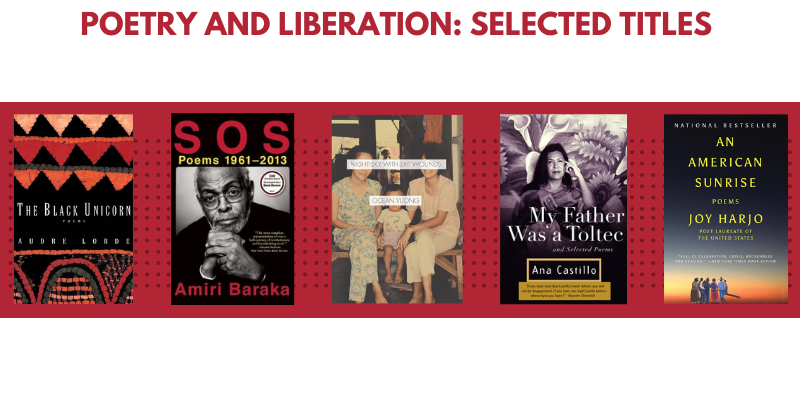
In the English 12 Poetry and Liberation unit, students read and write about poetry that speaks for a collective group of people. Recent examples include:
“A Litany for Survival” — Audre Lorde
“An Agony. As Now” — Amiri Baraka
“An American Sunrise” — Joy Harjo
“Aubade with Burning City” — Ocean Vuong
“I am Joaquin/Yo Soy Joaquin” — Rodolfo "Corky" Gonzales
“Napa, California” — Ana Castillo
In reading a variety of political works from key resistance movements, students make salient connections to real-world issues and experiences with (or knowledge of) racial inequality, LGBTQ+ rights, and immigration, among many others.
The Poetry and Liberation unit evolved from a 19th-century transcendentalism unit into a student-centered creative project that examines how marginalized poets subvert poetic forms and conventions (such as traditional structure and meter). Here is a brief overview of the assignment timeline:
- Students begin the unit studying transcendentalism, examining how poets apply transcendental beliefs to a real-world commitment to universal liberation.
- Then, each week, the class focuses on a specific protest movement from American history and discusses key themes relating to that movement through their readings.
- Through annotation, students analyze the use of language, poetic devices, and political context.
- To demonstrate their understanding of the thematic messages of each liberation movement, they write analytical responses, design sketchnotes, and participate in graded discussions.
Examples of High School Student Activist Poetry
By the end of the unit, students create a digital exhibit showcasing a contemporary social or political issue of their choice through poetry. They select and analyze a historical protest poem that shines light on that issue and write their own poetry in response to the historical poem, showing where the movement is now in the modern context.
The seniors’ online exhibit consists of the following sequence:
- Thoroughly annotated historical protest poem from or about a past resistance movement (poets chosen include Claude McKay, Charlotte Perkins Gilman, and Alice Moore Dunbar-Nelson).
- One-paragraph written analysis of that poem
- Original poem in response to the historical poem that connects it to a contemporary issue
- Visual illumination of the relationship between both poems
- Brief description of their illumination that explains the connections between the two poems.
For example, one student chose to adapt “Pencil” by Vietnamese author and activist Teresa Mei Chuc into her own work, titled “Paint.” Both poems are about the effects of war on ethnic civilian populations. Here is an excerpt from “Paint”:
You have seen this before,
And I get to see it now.
And look,
Seven million people leave their jobs to march down the street,
Until there is no street to be seen. There is only flesh, paper, and cloth.
We painted the streets, the buildings, our faces, our legs,
And a pencil cannot erase paint.
The student wanted her work to echo how Chuc’s poem highlights attempts at cultural erasure and how those in power are making their decisions from a different reality than others
Another student adapted Allen Ginsburg’s mid-20th century poem “A Supermarket in California” into his own work, “Wasteland,” about the effects of capitalism in the 21st century:
Is this how we want the next generation to live?
Our parents had it so much better.
don’t complain when all the nice stores at the mall go from
fancy fabrics in the fabulous windows to
plywood from the local landfill’s heap of scrap wood
zipped onto the window frames
with self tappers
The students’ scaffolded process — literary analysis, creative poem, artistic statement, and visual adaptation — helps them in several complementary ways. They are not only exposed to poetic language they can relate to on a personal level, but they also have the opportunity to survey and consider the thoughts and feelings of communities whose voices are often set to the margins.
As a result, students access language that empowers and reclaims joy as they use their creativity and strengths to understand diverse poets and poetic movements in individualized ways.
Additional Siena Resources
See The Siena School blog for more posts in our Teacher Resources category, including the benefits of Dyslexia-Friendly Book Editions and Unlocking History Through Hands-On Learning.
The Siena School, a nationwide dyslexia education leader currently in its 20th anniversary year, serves bright, college-bound students with language-based learning differences on campuses in Silver Spring, MD (grades 3-4 and 5-12) and Oakton, VA (grades 3-12).
Posted in
Teacher Resources