Empowering students with language-based learning differences

Siena Blog



News
The Siena School Blog
Discover, Learn, Celebrate, and Empower
Welcome to Siena's blog, your source for helpful, cutting-edge resources tailored to teachers, parents, and other advocates in the learning differences community. We are dedicated to providing a wealth of curated knowledge spanning various topics, ranging from dyslexia advocacy and awareness to classroom teaching strategies, heritage month profiles, and social and emotional health.
Discover innovative classroom strategies that inspire creativity and foster a love of learning.
Our commitment to social-emotional wellness ensures that we provide valuable insights into healthy student development and self-advocacy.
Discover resources, reading and podcast recommendations, volunteering opportunities, and more for parents in the LD community.
Our important heritage month posts highlight key people, offer reading and podcast recommendations, and more.
Unlocking History Through Hands-On Learning: Siena 6th Graders Explore Ancient Egypt
December 02, 2025
Avg. Read Time 3-4 min.
At The Siena School, learning is not something students simply absorb — it’s something they experience. In the Fall 2025 semester, 6th graders from Siena’s Forest Glen campus dove into the world of Ancient Egypt through immersive, multisensory projects designed to build deep understanding, spark curiosity, and make history come alive.
Hands-On Learning at Siena
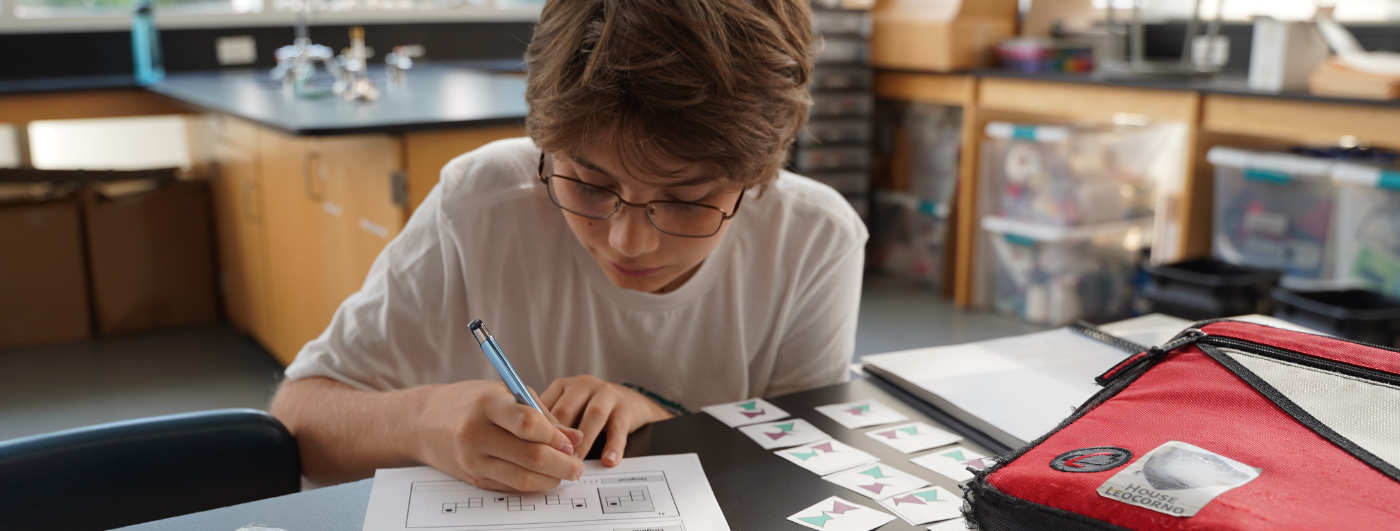
As part of their Social Studies unit on Ancient Egypt and pharaohs’ tombs with Siena middle school teacher Pinki Shah, students spent a week “mummifying” organs and crafting their own canopic jars. These creative activities highlighted the purpose and symbolism behind mummification, what was placed in a pharaoh’s tomb, and how Egyptians prepared for the afterlife.
Through the kind tactile learning that especially benefits students with language-based learning differences, the class explored:
- The religious beliefs that shaped burial practices
- The meaning behind preserving organs
- The artistry and ritual of canopic jars
- The human experience of preparing for an afterlife
This kind of experiential activity is exactly what Siena strives for — instruction that honors how bright, language-diverse learners thrive when given visual, hands-on pathways to understand complex material.
Mapping the Nile River
.jpg)
Lining the classroom walls are the students’ Nile River recreations — a vibrant visual demonstration of how geography shaped civilization. Ms. Shah’s students learned how the Nile flows from south to north, how the ancient Egyptians depended on the river’s predictability, and why pharaohs were buried at specific points along its banks.
By designing their own river systems, students used spatial reasoning, visual creativity, and multisensory design to grasp how environment, religion, and community structure intersected in Ancient Egypt.
Experiential Learning While Visiting Queen Nefertari’s Tomb
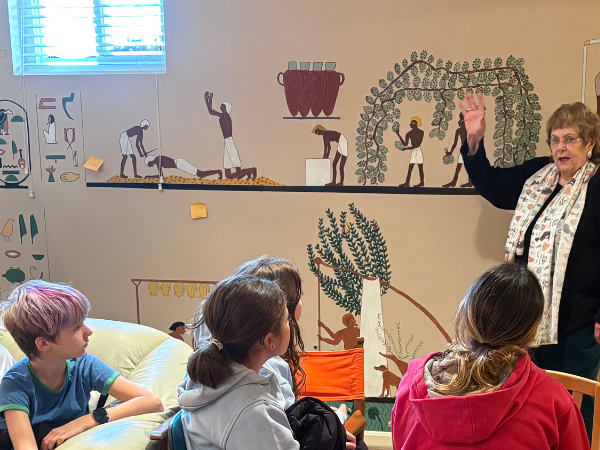
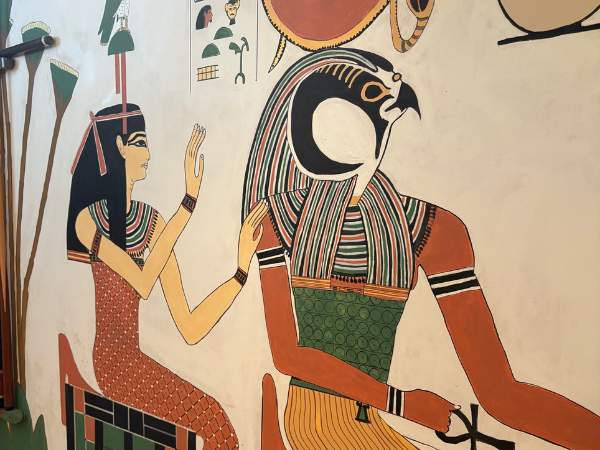
One of the highlights of the unit was a field trip to visit a detailed recreation of Queen Nefertari’s tomb at a nearby community member’s studio. Forest Glen 6th graders visited local resident and artist Emily, who spent three years hand-painting the tomb inspired by what she described as one of the “most beautiful” ancient spaces she saw during her travels. For Ms. Shah and her class, walking into the space felt like stepping back in time. Students were able to see:
- The religious symbolism painted on the walls
- Artistic styles used in royal burials
- The scale, colors, and storytelling that surrounded a queen’s journey to the afterlife
Students were quite impressed by this immersive art experience:
- “The art was so beautiful. I learned about the [scarab] beetles and how they walked around using the stars and found their way. I think it is really cool how she painted the whole basement [...]. Her art is beautiful and I'm glad I got to see it.” —Jayne
- “Her paintings were beautiful and I can't believe that she did them by herself! We learned about how she made them and why. She also talked about how she went to see an Egyptian tomb [in person]. She told us how they made the tombs and how they carved it. One new thing I learned is that the Egyptians carved in black granite with copper.” —Isabel
Emily’s meticulous and passionate work enriched students’ understanding far beyond what a textbook could provide. Her dedication to historical accuracy and artful recreation offered students an unforgettable (and tangible) connection to the content — and Siena is deeply grateful for her generosity.
Through project-based tasks, visual supports, creative expression, and real-world experiences like these, students not only learned history through this unit — they built meaning, made connections, and developed a richer understanding of human civilization.
Additional Siena Resources
See The Siena School blog for more posts of interest about Siena’s hands-on education, including The Benefits of Reading to Dogs, Making Career Possibilities Real for Students, and the benefits of Dyslexia-Friendly Book Editions.
The Siena School, a national leader in dyslexia education, serves bright, college-bound students with language-based learning differences on DC Metro area campuses in Silver Spring, MD (grades 3-4 and 5-12) and Oakton, VA (grades 3-12).
Posted in
Teacher Resources